

How the Versa Paddle Works
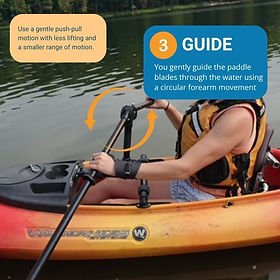
The Versa Paddle is designed to make paddling easier for people with limited strength, mobility or range of motion. By supporting the weight of the paddle and using a gentle push-pull motion, the system requires less lifting and movement—helping reduce strain on the shoulders and joints while creating a smooth, efficient stroke.


What Makes the Versa Different?
Unlike a standard straight paddle, the Versa is designed specifically for adaptive paddling. Its adjustable shafts can be lengthened or shortened and the paddle can be used straight or angled downward to accommodate different levels of strength and mobility.

Adjustable & Angled
Lengthen or shorten each shaft and paddle straight or angled downward.
Adaptable to Greater Needs
Designed for paddlers who may need a smaller range of motion or greater support, including many one-arm paddlers.
Use It Freestyle, Too
Remove the Versa from the mount and use it like a traditional paddle.

Gentle Motion
Like pedaling a bike with your hands
Is the Versa Paddle System Right for You?
No prior kayaking experience required. Versa is designed to make paddling possible across a wide range of strength, mobility and experience levels, including:

First-time paddlers who need added stability and confidence
Stroke survivors and people with neurological conditions
Paddlers with Ehlers-Danlos syndrome or joint instability
Veterans and paddlers with shoulder injuries or limited range of motion
Paddlers on the Autism Spectrum who benefit from rhythmic, low-effort movement
People with hemiplegia, quadriplegia, paralysis or limb difference
The Versa System in Action


What’s Included in the Versa Paddle System?
The Versa Paddle System is a complete, integrated system that includes:

Adjustable Paddle
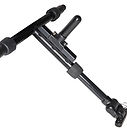
An adjustable kayak paddle with variable lengths and an omni-directional pivot function
Kayak Mount
One mount that attaches to your kayak, selected based on your kayak style

Support Post
A support post that slips on the mount to support the weight of the paddle
The paddle and support remain the same.
Choosing the Right Mount Matters
Your Versa Paddle System includes one mount, selected based on your kayak design and paddling goals. Most paddlers have a clear best option.
Our Strong Recommendation
Whenever possible, we recommend the Hinged Mount with a sit-inside recreational kayak. It generally provides the most secure, stable setup—particularly for paddlers with limited strength or coordination.

Most Recommended
Hinged Mount
Our most stable option. Attaches securely around the cockpit coaming of recreational sit-inside kayaks and delivers the best long-term experience for most users.
Recommended
Versatile Alternative
Apex Mount
Works with select sit-inside, sit-on-top kayak and SUP styles when a Hinged Mount isn't compatible. A solid second-best option in many situations.
For Specific Setups
Twin Track Mount
Designed for sit-on-top kayaks. Best for individual users; not recommended for high-use program environments. Additional custom mounts also available.
Why Versa Works When
Traditional Paddling Doesn't
Adaptive paddling isn't about doing less. It’s about removing the barriers that make kayaking painful, exhausting or unpredictable.

Reduces Joint Stress & Strain

Can Be Used with One Arm
Avoids Fatigue Flareups
Requires a Smaller Range of Motion
More Forgiving When Coordination Varies
Real Stories from Paddlers Like You
"Great system! After my wife had a massive stroke a year ago with left side paralysis, we never expected her to kayak again. We were thrilled with how easy it was to use the Versa Paddle System for Sit-Inside Kayaks. New freedom!"

Paul A.
Wyoming
"I am a one-armed paddler and used the Versa System for three years. I am a huge fan! Through your instructional materials and videos, I am confident my system is set up properly for my kayak and body type. The paddling experience is great! Overall, I could not be satisfied!"
Rusty H.
Wisconsin
"It's a great product. On nice days when the program is running, we always use at least one!"
Keisha L.
Ottawa River Canoe Club
"I had a stroke three and half years ago. This has been the first time (I've used) Angle Oar!!! I was crying because it who it is (who I am) supposed to be. I always was a kayaker, and I will be now!"
Tressa S.
Maine
Trusted by Rehabilitation & Recreation Programs
The Versa Paddle System is used by individuals and by the programs that support them.
Physical & Occupational Therapists
Rehabilitation & Adaptive Recreation Programs
Kayakers with Disabilities or Injuries
Parks & Recreation Departments
Kayak Rental Programs & Nature Centers
Designed to support independence while making kayaking feel safe, approachable and achievable.
Clear Guidance - from Set Up to Your First Paddle
The Versa Paddle System performs best when positioned and installed properly. Most paddlers also benefit from a few quick tips before their first paddle as the stroke technique is slightly different. Small adjustments can make a big difference in comfort, endurance and enjoyment.

Not Sure Whether the Gamut or Versa System
Right for You?
The Versa System may be a good fit if you need greater adaptability, have more significant strength or mobility limitations, or benefit from a smaller range of motion. The Gamut System is generally better suited to paddlers with mild to moderate strength or mobility challenges who can still use a standard straight paddle.
Frequently Asked Questions
Why is the "angle" of the Versa Paddle System so important in adaptive paddling?
We're glad you asked. We regularly hear from phyiscal and recreational therapists, individual paddlers, and adaptive program managers about how important the angle is for certain paddlers. They'ye shared the top three reasons it's important, and we've posted those reasons in this blog.
In addition, you can learn more about the firsthand benefits our founder learned of from her doctors after rotator cuff surgery, here.
Why do you sometimes refer to Versa and Gamut as "systems"?
The Versa Paddle and the Gamut Paddle Holder comes with one of several mounts, designed to support the weight of the paddle. You can't get the advantages of stress reduction, smaller range of motion, etc. without using the mount. For this reason, both products are part of a package, or system. The price includes both the paddling device and the mount.
Who uses the Versa Paddle System?
The Versa Paddle System is used by a wide range of individuals and organizations, including adaptive paddling programs, summer camps, veterans and military organizations, physical therapists and rehabilitation clinics, outfitters, and community parks and recreation programs.
Versa is used by paddlers with many different abilities and experiences—some are experienced kayakers, while many are first-timers. Users include people who have had strokes, paralysis, limb difference or amputation, neuromuscular conditions, cerebral palsy, PTSD, autism, and other physical or cognitive disabilities. Versa is also used by older adults with limited strength, paddlers recovering from shoulder injuries, and children who are new to kayaking.
Because Versa is highly adjustable, it works well for families, group programs, and rental settings where multiple paddlers share equipment. Its flexibility makes independent kayaking possible for people who might not otherwise be able to paddle.
You can see real-world examples on our Adaptive Kayaking page, YouTube channel, and blog, where paddlers share their experiences using Versa.
Which kayak mount should I choose to work with either the Versa or Gamut Systems?
For sit-inside recreational kayaks, we strongly recommend the Hinged Mount whenever possible. If that isn’t compatible, the Apex Mount is typically the next best option. The Twin Track Mount is designed for specific sit-on-top. If you’re unsure, we’re happy to help you choose. You can read about our mounts here.
What’s the difference between Versa and Gamut and when would I use each?
Both the Versa Paddle System and the Gamut Paddle Holder System work with all of our mounts (with the Hinged Mount generally recommended for sit-inside kayaks).
The Versa Paddle System is a complete paddle system that can be used angled downward in the mount, straight in the mount or straight off the mount like a traditional paddle. Each shaft is adjustable in length (approximately 220–255 cm). When used in the angled position, Versa significantly reduces reach, shoulder elevation, and repetitive motion. This makes it especially well suited for paddlers with limited hand or wrist dexterity, reduced upper-body strength, shoulder injuries or more significant mobility limitations, as well as for adaptive paddling programs.
The Gamut Paddle Holder System does not include a paddle—you use your own. Because of this, the paddle remains in the straight position and cannot be angled downward. Gamut is often preferred by experienced or long-term paddlers who want to continue using their favorite paddle while managing arthritis, joint pain, shoulder injuries or reduced endurance. It’s also popular with paddlers who like to alternate between traditional paddling and mount-supported paddling during an outing, and with anglers who appreciate being able to let go of the paddle without re-securing it. A paddle length of 240–260 cm or longer is recommended.
In broad terms, Gamut is often a good fit for paddlers with mild to moderate injuries or mobility limitations, while Versa is typically better for paddlers with more significant disabilities or mobility challenges, though individual needs vary.
What makes the Versa Paddle System so versatile?
Versa was designed to adapt to different paddlers, kayaks, and conditions—hence the name. Each paddle shaft adjusts to one of three lengths, accommodating different deck heights and kayak widths, with a total length range of 220–255 cm.
Versa can be used in multiple ways: angled or straight while mounted, or removed from the mount and used as a standard straight paddle. Depending on the mount, the system can also be moved forward or back, raised or lowered, and fine-tuned to fit a wide range of kayaks.
For convenience and transport, the paddle shafts disassemble easily, and the mount can be removed when not in use. Optional paddle bags are available to keep everything protected and stored together.
Learn more here.
What is the ideal positioning of the Versa Paddle or Gamut Paddle Holder System relative to my torso?
What we say in the installation instructions regarding “ideal” positioning is to try the placement on dry land first and see what “feels right” to you, which may vary from person to person. One good rule of thumb, however, has to do with placement of your elbows. With the Versa Paddle angled downward on both sides and your hands in a neutral (e.g., 10 and 2 o’clock position) on the shafts, your elbows should be down by your sides and your hands will be at about chest height. There may be some space between each arm and the sides of your torso, but the elbows shouldn’t be too far in front of your body.
When using the Versa Paddle straight, your elbows will come up and slightly forward from your body when in a resting position and your hands should be slightly above chest level at about shoulder height. The paddle itself will generally be 12 to 18 inches away from your torso, but it will vary for each individual.
With the Gamut Paddle Holder, your elbows will be slightly raised and forward (e.g., about 45 degrees) in a resting position. Your hands should be just at about chest level. And finally, your arms shouldn’t be all the way straight; they should have a slight bend in them.
You can learn more on this blog post.
What happens if the kayak capsizes? Are the Versa and Gamut Systems safe?
Yes. Angle Oar's products were engineered with safety as a core priority. The Hinged Mount includes built-in quick-release functionality that activates automatically in the event of a capsize. When the kayak tips, gravity and the paddler’s body weight cause the mount to open, allowing the paddler to fall freely out of the cockpit. There are no levers to pull or actions required—it happens effortlessly.
You can see a demonstration here.
As with any form of kayaking, safety preparation is important. We strongly recommend taking appropriate paddling or adaptive kayaking instruction, practicing in a controlled environment (such as a pool or calm water), always wearing a properly fitted PFD, and paddling with a companion when possible. Many paddlers also choose to add our outriggers for increased stability and an extra layer of confidence on the water.
Many, but not all customers, also choose to purchase a set of our outriggers to add even more stability and peace of mind when they kayak.
I’ve had shoulder surgery or have a significant shoulder injury. Can Versa or Gamut help me continue to paddle?
We always recommend making this decision in consultation with your physician or physical therapist. That said, many Angle Oar customers recovering from rotator cuff injuries, shoulder surgery or managing arthritis and chronic shoulder pain have successfully returned to kayaking using our systems.
The Versa Paddle System and the Gamut Paddle Holder System can be used as a transitional or long-term solution for paddlers who experience pain or limited mobility with traditional paddling. Versa, in particular, reduces shoulder elevation and range of motion when used in the angled position, which can be especially helpful during recovery or for ongoing shoulder limitations.
Gamut can also be beneficial for paddlers who want added support and control while continuing to paddle with a straight, traditional paddle. By stabilizing the paddle and reducing the need for gripping and corrective movements, it may help limit shoulder strain during longer outings or periods of fatigue.
We’ve shared several real-world stories on our blog showing how paddlers with shoulder injuries have returned to the water using Versa or Gamut.
Is kayaking with the Versa Paddle or Gamut Paddle Holder Systems different from regular paddling?
Yes. Versa and Gamut are a mount-supported, adjustable paddle systems designed to reduce the physical demands of traditional kayaking. The mount supports the weight of the paddle and minimizes torso rotation and shoulder movement. Instead of full paddle strokes, propulsion comes from a simple rotary motion of the forearms.
Gamut uses your own paddle which you can leave in the mount-supported RotoGrips or take out and use free style.
Versa can be used in three ways: mounted and angled (about 25°) to simulate a sweep stroke, mounted and straight (180°) for a forward stroke, or removed from the mount and used as a standard straight paddle. Many paddlers switch between these modes during a single outing, depending on conditions.
For recreational paddlers, Versa and Gamut feel somewhat similar to traditional kayaking—but allows longer time and distance on the water with far less strain. They're especially helpful for paddlers with limited strength, mobility, injuries or fatigue.
I'm confused. Is it called the Versa Paddle or Angle Oar?
That’s a common question. Angle Oar is the company name, and Versa is the product name.
When we first launched, the paddle itself was also called the Angle Oar because the design combines elements of both a paddle and an oar. Over time, we realized the word “oar” caused confusion for kayakers, since kayaks don’t typically use oars.
To make things clearer, we renamed the product Versa, short for versatile paddle. Today, we refer to it as the Versa Paddle or Versa Paddle System, while the company remains Angle Oar. You may still see some legacy terminology in older videos or materials.
By the way if you want to understand the difference between a paddle and an oar, read this blog.
How does the Versa Paddle protect shoulder function?
For paddlers with paralysis, limb difference or a history of shoulder surgery or rotator cuff injury, protecting shoulder function and range of motion is critical—especially when relying heavily on one arm. Repetitive overhead movement or excessive reach can quickly compromise long-term shoulder health.
The Versa Paddle System allows paddlers to shift more effort to their stronger or more functional side, reducing strain on a compromised shoulder. When mounted and angled downward, Versa requires only minimal range of motion, with the hands staying close to the 10 and 2 o’clock positions. This significantly reduces shoulder elevation, repetitive stress and joint loading compared to traditional paddling.
This supported pivot also means less torso rotation is required compared to traditional paddling, which can further reduce stress on the shoulder and upper body over time.
Because of these benefits, physical and recreational therapists frequently recommend Versa for clients who need to preserve shoulder function while remaining active on the water. For more detail, see our articles on torn rotator cuff recovery and kayaking and managing shoulder injuries and arthritis while kayaking.
How do you adjust the lengths of each Versa Paddle shaft?
There are three push buttons on each Versa Paddle shaft, allowing you to have longer lengths (e.g., for a wide kayak) or shorter, depending on your needs. The Versa Paddle can be adjusted from 220 - 255 cm in length. This short video, which features an earlier version of our equipment, shows it works.
For what types of kayaking are the Versa Paddle System and Gamut Paddle Holder System best suited?
The Versa Paddle is not a "performance" paddle. We designed it for novice and recreational kayakers, primarily in flat water conditions such as lakes and gentle streams. It can also be used for longer trips and calm water recreational ocean paddling, if desired. It is not intended for whitewater kayaking or other high-skill, high-demand conditions.
The Gamut Paddle Holder System uses your own paddle, but while it’s in the holder, it’s intended for the same calm, flatwater environments as the Versa. If you remove the paddle from the holder and paddle normally, you can use it just as you would any standard paddle. Like the Versa, the Gamut is not designed for whitewater or other high-skill, high-demand conditions while mounted.
Does the Versa or Gamut Systems float?
We included floation foam in the lower ends of each paddle shaft, however, there are other components on the paddle and mounting systems where we weren't able to add flotation material. As a result, the Versa Paddle has some flotation ability, but it not guaranteed to float since the angled section that joins the two shafts is made of aluminum.
Adding spray foam to the paddle shafts may provide slightly more flotation, but again, it's not a guarantee. Spray foam can be used in any open compartments, but be sure not to fill the shafts past the first push pin hole or you will not be able to adjust the paddle lengths as intended.
Another low-tech option is to purchase pool noodles, cut them into roughly 8" lengths, and cut an opening lengthwise. Put one segment on each side of the blade, making sure it doesn't hinder the placement of the paddler's hands or the function of the paddle.
The Hinged Mount that supports the clevis and paddle flip open upon capsize and should remained affixed to the kayak itself.
We have also added a small d-ring to the clevis post that supports the Versa Paddle or Gamut Paddle Holder. You can purchase an inexpensive tether to keep the clevis post attached to the main mount so the clevis doesn't fall out of the kayak, as it will sink.
If you're using the Gamut Paddle Holder, you'll be using your own paddle, so see your manufacturer's information to know if it floats.
Does the Versa Paddle System or Gamut Paddle System come with a mount?
Yes. Both the Versa Paddle System and the Gamut Paddle Holder System include one kayak mount with purchase.
Because kayaks vary widely in cockpit design, rail systems and deck layout, the mount is selected based on your specific kayak. This ensures proper positioning, stability and comfort once the system is installed.
During the ordering process (or as part of a consultation), we help determine which mount option is the best fit for your kayak and intended use. If you already know your kayak model or have photos available, that information can be especially helpful in making the right selection.
Additional or alternate mounts can also be purchased separately if you plan to:
Use the system on more than one kayak
Share equipment across a fleet or program
Experiment with different mounting positions
To learn more about the available mount options and how they differ, you can explore them here:
Can Versa or Gamut be used with inflatable kayaks?
The short answer is "possibly." Our new Apex Mount has the ability to work with inflatable kayaks, using one of several different attachment methods. See our Mounts page for details.
The Apex Mount may be an option for paddlers who need to mitigate strength or mobility challenges in their shoulders/upper body. Please be aware, however, that the undulating water beneath the floor of the inflatable kayak causes the base mount to move around quite a bit. If you're willing to accept a fair amount of side-to-side movement and/or potentially use your legs to help keep the Apex Mount in place, then it can certainly work.
We are continuing to test the Apex Mount on different types of inflatables. We suspect the Apex Mount may be do better with inflatable kayaks that have drop stitch floors, as they are more rigid than those with standard PVC construction.
Can Versa or Gamut be used with canoes?
For the most part, no. We say that because, although they were designed for kayaks, which sit much lower in the water, at least one group has attached our Hinged Mount and Versa Paddle to a canoe. The main issue is whether the shafts extend far enough to reach the water. In addition, a canoe is much longer than the average kayak, and so the "rowing" motion of having a blade on each side is different than the typical single-blade used on either side of a canoe.
If you are interested in trying a Versa on your canoe, please give us a call or email us at info@angleoar.com and we'll do our best to see if it might work, perhaps with some slight modifications.
Our outriggers, however, are definitely compatible with canoes and come with dedicated attachment hardware for both kayaks and canoes.
Can Versa or Gamut be used on foldable kayaks?
Yes. In 2023, we introduced a new mount called the Apex Mount. It uses patented sticky cups to adhere the mount to the floor of the kayak. The Apex Mount requires a relatively flat surface in front of the seat of roughly 8 x 12 inches. See our Mounts page for details.
The Apex Mount can be used with either the Versa or Gamut system.
Can Versa or Gamut be used on a tandem kayak?
Absolutely! We suggest several compatible kayak brands on our website, but it's also worth noting that some of our creative customers have found ways to use Versa or Gamut in both the front and back seat! Feel free to contact us if you'd like some pointers on how to attach the Hinged Mount to the rear seating area.
Can I use the Versa or Gamut Systems with a stand-up paddleboard (SUP)?
Yes. Both the Versa Paddle System and the Gamut Paddle Holder System can be used with a stand-up paddleboard when paddling from a seated position. Because stand-up paddling can be demanding on the shoulders, back, legs and core, the mount supports the weight of the paddle and reduces physical strain when you need or prefer to sit.
Versa and Gamut were designed to give paddleboarders more flexibility during their outings and to make paddleboarding accessible for people who are unable to stand or who have mobility limitations.
Can I use Versa like a straight, traditional paddle?
Absolutely! In fact, one of the main benefits of Versa is that you can use it either way. If you want the "weightless" functionality, the paddle slips easily into vertical support post which rests atop a the mount. In the mount, the paddle can be used either angled downward or straight.
With a gentle tug, the paddle pops out. If it was in the angled mode, you use a simple slidable thumb pin to change the angle to 180 degrees (i.e., straight) to use it free form. In fact, we've found it useful to use the paddle in "straight mode" when launching and exiting the kayak, and in "angle mode" on the open water. The only slight difference between the Versa Paddle in "straight mode" and a regular paddle is that there is a 2" steel pin that holds the two shafts of Versa together. That pin protrudes slightly on either side when not resting in the vertical post.
Can I paddle with one arm?
Yes. Both the Versa Paddle System and, in some cases, the Gamut Paddle Holder System can be used by paddlers who paddle with one arm. Many Angle Oar customers with hemiplegia, paralysis, limb difference, stroke, and other mobility limitations paddle successfully using these systems.
For sit-inside kayaks, the Hinged Mount attaches to the front and side coamings, creating a stable, centralized support point. This keeps the paddle secure and allows the blade to enter the water on both sides smoothly—without wobbling or unwanted pivoting. That stability makes it possible to maintain control and direction even with one hand or limited strength or coordination.
This stability is what makes independent kayaking possible for many paddlers who would otherwise be unable to paddle with a traditional paddle.
Some paddlers also use the Gamut Paddle Holder System with one arm. In these cases, the primary consideration is how evenly force (torque) is applied from side to side. If the force is significantly different between sides, the paddle shaft may tend to pop out of the roller grip on the less dominant side. To help address this, RotoGrip Snap-N-Straps are available to help keep the paddle securely in place while still allowing smooth movement.
This video shows how several of Angle Oar's customers paddle with one arm.
Are there any kayak or paddle specifications I should be aware of to use the Versa or Gamut systems?
The specifications for Versa or Gamut have to do with the mount you choose, moreso than the paddle systems itself. Our Compatible Kayaks page provides a starting place to find the kayaks that work best with which of our mounts.
Kayak Style
First, identify whether you'll be using a sit-inside kayak, a sit-on-top kayak or a SUP. That will determine which mounts are available to use. (Note: We do recommend using our Hinged Mount with sit-inside kayaks whenever possible as it provides the most stability.)
Choose a Mount
You can see a full list of "fit" specifications on our Mounts page for each style of mount, along with demo videos. Under each mount style, you'll find information as well as a link to specific kayak and installation specifications.
Not Sure About the Fit?
Some customers have created their own modifications to our mounts to add stability. You can see examples in this blog.
If you're ever unsure which mount to choose, drop us a line at info@angleoar.com and include 2-3 photos of your cockpit area, and we'll be happy to make a recommendation.
Are the Versa or Gamut Systems hard to install or learn?
Most customers find setup straightforward using our installation instructions and videos. Like any adaptive equipment, Versa works best once properly fitted and paired with the right technique. We're here to provide you support and performance tips. Just ask!