
Shoulder Strengthening Exercises for Kayakers: A Science-Based Guide

Kayaking may look peaceful from the shoreline, but your shoulders know better. Every outing involves hundreds—and sometimes thousands—of repeated strokes requiring the muscles of the shoulders, upper back and core to work together.
That repetition helps explain why shoulder problems are so common among paddlers. In one study of 583 paddle-sport competitors, the shoulder accounted for 31% of reported paddling-related injuries, making it the most frequently injured area. A smaller study of competitive flatwater kayakers found that nearly 55% had experienced shoulder pain.
Fortunately, a well-designed strengthening program can help prepare your shoulders for the demands of paddling. The goal isn’t simply to build bigger shoulder muscles. It is to improve rotator-cuff strength, shoulder-blade control, endurance and core stability so your entire upper body can share the work.

Already experiencing pain or recovering from an injury? Start with Shoulder Injuries: Why Kayakers Are Prone to Them and What to Do About It. If you have experienced a rotator-cuff tear, you may also want to read Beyond the Scalpel: Torn Rotator Cuff, Kayaking and the Path to Full Recovery.
Why Shoulder Strength Matters for Kayakers
The shoulder is extremely mobile, but that mobility comes at a price: it depends heavily on muscles and tendons for stability.

The four rotator-cuff muscles help keep the upper-arm bone centered in the shoulder socket. Meanwhile, muscles around the shoulder blade—including the trapezius, rhomboids and serratus anterior—position and stabilize the scapula as the arm moves.
Paddling also relies on the larger muscles of the back, chest and arms, but those muscles cannot work efficiently if the smaller stabilizers fatigue or the shoulder blade moves poorly.
Research involving kayakers supports this connection. In a study of 31 competitive flatwater paddlers, 15 of the 17 participants who reported shoulder pain also demonstrated scapular dyskinesis—an alteration in the position or movement of the shoulder blade. Those with shoulder pain also had less internal-rotation range of motion than paddlers without pain.
The study was small and involved competitive paddlers, so its findings should not be applied to every recreational kayaker. It does, however, suggest that shoulder-blade control, rotational mobility and balanced shoulder strength deserve attention in a paddler’s training program.
Six Useful Shoulder and Core Exercises for Kayakers
These exercises are intended as general conditioning, not as treatment for a diagnosed injury.
Begin with light resistance, move slowly and stay within a comfortable range of motion.
If an exercise causes sharp or increasing pain, numbness, significant weakness or a sensation that the shoulder is slipping or unstable, stop and consult a physician or physical therapist.
1. Resistance-Band External Rotation
External rotation targets the infraspinatus and teres minor, two rotator-cuff muscles that help stabilize the shoulder during the paddle stroke.
How to do it:
Attach a light resistance band to a secure object at approximately elbow height.
Stand sideways to the anchor and hold the band with the hand farthest from it.
Bend your elbow to 90 degrees and keep it close to your side. Placing a small, folded towel between your elbow and ribs can help maintain the position.
Slowly rotate your forearm away from your body without allowing your elbow to drift outward.
Return slowly to the starting position.
Start with two sets of 8 to 12 repetitions on each side. Increase the resistance only when you can complete the movement without shrugging, twisting or losing control.

The American Academy of Orthopaedic Surgeons’ shoulder-conditioning program includes illustrated directions for this exercise and several appropriate progressions.
2. Standing Resistance-Band Row
Rows strengthen the muscles of the upper back and shoulder blades, particularly the middle and lower trapezius. These muscles help keep the shoulders from rolling forward as fatigue sets in.
How to do it:
Secure a resistance band in front of you at about waist or chest height.
Hold one end in each hand with your elbows bent and close to your sides.
Pull your elbows backward while gently drawing your shoulder blades together.
Avoid shrugging or forcing the shoulder blades together as tightly as possible.
Pause briefly, then return slowly.
Begin with two sets of 8 to 12 repetitions. Build toward three sets as the movement becomes easier.
Think of this as a controlled upper-back exercise, not a contest to see how far behind you your elbows can travel.

3. Side-Lying External Rotation
This is another effective way to train the posterior rotator cuff, but it uses a light dumbbell rather than a resistance band.
How to do it:
Lie on one side with the arm you are exercising on top.
Bend the top elbow to 90 degrees and keep it against your side.
Hold a very light dumbbell—or begin with no weight.
Keeping the elbow in place, slowly rotate your forearm upward.
Stop before your body begins rolling backward, then lower the weight slowly.
Rotator-cuff muscles are relatively small, so this is not an exercise that calls for a heavy dumbbell.
Begin with 1 to 3 pounds and focus on control.

4. Full-Can Raise
The full-can exercise strengthens the supraspinatus and deltoid while placing the arm in a generally more shoulder-friendly position than the traditional “empty can” exercise.
How to do it:
Stand with your arms at your sides and your thumbs pointing upward.
Move your arms slightly forward so they are approximately 30 degrees in front of your body rather than directly out to the sides.
Slowly raise both arms to about shoulder height.
Keep your thumbs up and avoid shrugging your shoulders toward your ears.
Lower your arms slowly.
Start without weights or use weights of only 1 to 3 pounds. Try two sets of 8 to 12 controlled repetitions.
If raising your arms to shoulder height is uncomfortable, use a smaller pain-free range. Do not push through a painful arc in the hope that the shoulder will “loosen up” after several repetitions.

5. Wall Slide with Serratus Reach
The serratus anterior helps rotate and stabilize the shoulder blade as the arm moves. Wall slides provide a relatively gentle way to train that coordination.
How to do it:
Stand facing a wall with your forearms resting against it.
Keep your ribs from flaring and gently engage your abdominal muscles.
Slide your forearms upward while allowing your shoulder blades to rotate naturally.
Near the top, gently press your forearms into the wall as if pushing your upper back slightly away from it.
Slide slowly back to the starting position.
Perform two sets of 8 to 10 repetitions. Stop before your shoulders shrug or your lower back arches.
A resistance band can eventually be placed around the forearms, but the unresisted version is a better starting point for many paddlers.

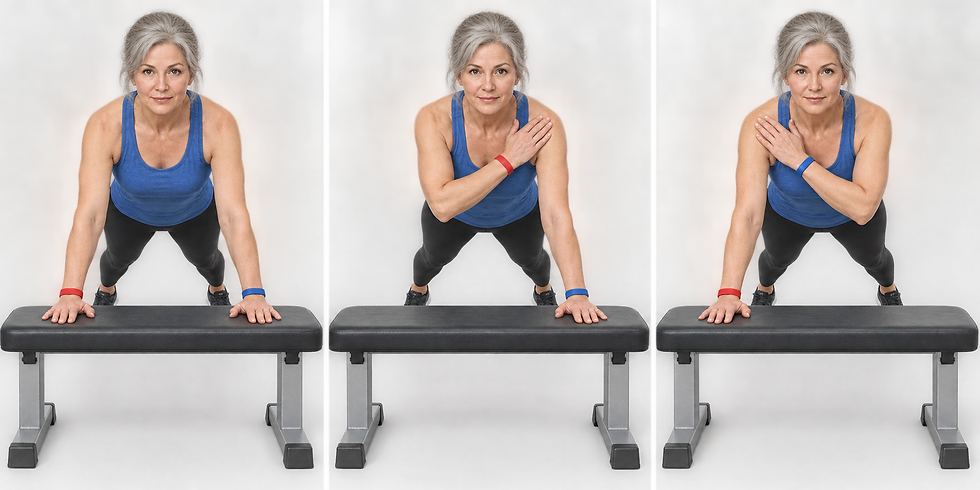
6. Plank with Shoulder Taps
Strong shoulders work best when they are connected to a stable trunk. Plank shoulder taps challenge the shoulders, serratus anterior and core while requiring the body to resist rotation.
How to do it:
Begin in a high-plank position with your hands beneath your shoulders and your feet slightly wider than hip-width.
Tighten your abdominal muscles and keep your hips as level as possible.
Lift one hand and tap the opposite shoulder.
Return the hand to the floor and repeat on the other side.
Move slowly rather than shifting quickly from side to side.
Begin with 6 to 10 taps per side.
If the full plank is too demanding, perform the exercise with your hands on a sturdy counter or bench. The elevated version still trains shoulder and core stability while placing less weight through the arms.
Why Shoulder Presses and Upright Rows Aren’t Our First Recommendations
Shoulder presses, upright rows and lateral raises frequently appear in general shoulder workouts. However, they are not necessarily the best starting exercises for recreational kayakers—particularly those with a history of shoulder pain or limited mobility.
Overhead shoulder presses
An overhead press can be useful for someone with healthy shoulders, sufficient mobility and good technique. It primarily strengthens the larger deltoid muscles and triceps, however, rather than isolating the smaller stabilizers that are a priority in this routine.
Overhead pressing may also be uncomfortable for someone with a rotator-cuff injury, painful arc, arthritis, frozen-shoulder history or limited overhead motion. It is better treated as an optional progression than as a universal shoulder exercise.
If you include overhead presses, begin with light resistance, remain within a pain-free range and consider asking a physical therapist or qualified trainer to assess your form.
Upright rows
During an upright row, the arm is elevated while the shoulder is internally rotated. That combination can be uncomfortable or irritating for some shoulders, especially when the elbows are pulled high or the exercise is performed with heavy resistance.
Because rows, external rotations and full-can raises can strengthen many of the relevant muscles without placing the shoulder in the same position, we have not included upright rows in this introductory program.
Lateral raises and rear-delt fly exercises
These exercises can be appropriate for healthy shoulders, but they overlap with the full-can raise, rows and other movements already included here.
More exercises are not necessarily better—especially when paddling itself contributes significant repetitive volume. A short, balanced routine performed consistently is more useful than a lengthy routine that leaves your shoulders too fatigued to paddle comfortably.
A Simple Weekly Shoulder Routine
For a generally healthy paddler, a basic routine might look like this:
Two or three nonconsecutive days per week:
Resistance-band external rotation: 2 sets of 8–12
Standing resistance-band row: 2 sets of 8–12
Side-lying external rotation: 2 sets of 8–12
Full-can raise: 2 sets of 8–12
Wall slide with serratus reach: 2 sets of 8–10
Plank shoulder taps: 6–10 per side
Before beginning, warm up for 5 to 10 minutes with walking, a stationary bicycle or another light activity. You can also perform a few gentle, unresisted paddle motions and comfortable trunk rotations.

The American Academy of Orthopaedic Surgeons recommends performing the strengthening exercises in its general shoulder-conditioning program three days per week. It also advises beginning with resistance that allows good technique and progressing gradually.
For paddlers, two sessions per week may be sufficient during a busy paddling season, particularly if time on the water is already high. Three sessions may be appropriate during the off-season or when paddling less frequently. Allow at least one recovery day between strengthening sessions.
Strength Is Only Part of Shoulder Protection
Shoulder conditioning helps, but it cannot compensate for every other problem. Paddlers should also pay attention to technique, training volume, equipment and recovery.
Increase paddling time gradually
Sudden increases in distance, speed or days on the water can overload tissues that are not prepared for the additional work. Add time or intensity in small increments rather than making a dramatic jump on one weekend.
Use your torso, not just your arms
Efficient paddling distributes the work across the torso, back and shoulders. Excessive pulling with the arms can cause the smaller shoulder muscles to fatigue more quickly.
Keep your hands within a comfortable working area
Repeatedly reaching high or far away from the body increases the demands on the shoulder. Good instruction can help recreational paddlers develop a lower, more efficient stroke when conditions allow.
Check paddle length and kayak setup
A paddle that is poorly matched to the paddler and kayak may encourage excessive reach or awkward positioning. Seat support, foot-brace position and posture can also influence how force travels through the body.
Listen to pain early
Muscle fatigue after a new workout is different from sharp pain, night pain, persistent weakness or pain that worsens with every outing. Continuing to paddle through those symptoms can turn a manageable problem into a much longer interruption.
Dealing with more than ordinary muscle soreness? Learn about common kayaking-related shoulder problems and ways to reduce strain in Shoulder Injuries: Why Kayakers Are Prone to Them and What to Do About It.
Returning to Kayaking After a Rotator-Cuff Tear
A rotator-cuff tear requires more individualized guidance than a general shoulder-conditioning article can provide. The appropriate exercises and return-to-paddling timeline will depend on the location and severity of the tear, whether it was treated surgically, the paddler’s age and health, and progress in rehabilitation.
Strengthening should be introduced according to the plan provided by the treating physician or physical therapist—not simply because an exercise appears on a general fitness list.
Angle Oar founder Meg McCall experienced this process firsthand after a torn rotator cuff and frozen shoulder interrupted her own paddling. Read Beyond the Scalpel: Torn Rotator Cuff, Kayaking and the Path to Full Recovery for a closer look at treatment, rehabilitation and returning to the water.
Helping a client return to kayaking? Download the free Adaptive Kayaking for Rehab & Recovery Guide, created for physical, occupational and recreational therapists, rehabilitation clinics and other professionals helping people return to the water.
When Shoulder Strengthening Isn’t Enough

Exercises can improve strength and endurance, but they do not remove the physical demands of repeatedly lifting and controlling a kayak paddle.
Paddlers with arthritis, limited range of motion, use of only one arm, a history of rotator-cuff surgery or ongoing shoulder pain may benefit from adaptive equipment. A mount-supported paddle system holds the paddle’s weight and allows the paddler’s arms to guide its movement rather than repeatedly lifting and stabilizing the entire paddle.
Angle Oar’s Versa Paddle System can be used in an angled or straight position. When angled, it brings the hands and elbows closer to the body and requires a smaller range of shoulder movement than traditional paddling.
The Gamut Paddle Holder supports a paddler’s existing straight paddle and may be appropriate for experienced paddlers who want assistance managing fatigue, arthritis or discomfort.
Adaptive equipment does not replace strengthening, medical care or sound technique. It can, however, reduce the physical demands of paddling so some people can remain active without asking an injured or vulnerable shoulder to do all the work.

Not sure which type of paddle support might help? Compare the Versa Paddle System and Gamut Paddle Holder, or contact Angle Oar for help choosing equipment for your needs and kayak.
The Bottom Line
The best shoulder program for kayakers is not necessarily built around heavy overhead lifting. It focuses on the smaller rotator-cuff muscles, the muscles that control the shoulder blades, the upper back and the core.
Consistency matters more than weight. A short routine performed two or three times a week—with good form and gradual progression—is more useful than an ambitious program completed twice and then quietly abandoned.
Strong shoulders can help you paddle more comfortably and efficiently. Pair that strength with good technique, reasonable training volume and equipment suited to your body, and you give yourself a better chance of enjoying many more days on the water.
This article provides general educational information and is not a substitute for medical advice, diagnosis or individualized rehabilitation. Consult a physician or physical therapist before beginning a new exercise program, particularly if you have pain, weakness, a previous shoulder injury or surgery.
Sources and Additional Exercise Guidance
Angle Oar is dedicated to helping people with limited strength or mobility experience the joy of kayaking for the first time, and to support experienced paddlers in continuing to participate in the sport. We offer a range of adaptive equipment, including Versa Paddle System, Gamut Paddle Holder, outriggers and more, specifically designed for individuals with physical disabilities, shoulder injuries, or reduced upper body strength due to age, injury or other conditions.


