
Which Angle Oar Paddle Mount Will Fit Your Kayak? A Visual Guide

Wondering whether you can use an Angle Oar paddle system with your kayak? The first step is finding the right kayak paddle mount.

Our Versa Paddle System and Gamut Paddle Holder use a mount attached to your kayak to support the paddle while you paddle. We offer several mount styles because kayaks vary so much in shape, seating position and available space.
Some mounts attach around the cockpit of a sit-inside kayak. Others attach to the deck or floor in front of your seat. The right choice depends on your kayak's design and a few measurements.
Use the photos and diagrams below to see what to look for on your own kayak.
Start with Your Kayak's Layout
Whenever possible, we recommend pairing our paddle systems with the Hinged Mount and a compatible sit-inside recreational kayak. Its three-point attachment provides the most stable support for the paddle system and the most stable paddling experience of our mounting options.
Before reaching for a tape measure, take a look at three things:
Kayak type: Is it a sit-inside, sit-on-top, fishing or foldable kayak?
Mounting area: What space is available around the cockpit or directly in front of your seat?
Surface and seat height: Is that area mostly flat? Are there ridges, hatches or cupholders in the way? How high do you sit?
Your kayak's make and model are helpful starting points, but its actual layout and measurements will help us narrow down the options.
Hinged Mount: Check the Rim Around Your Sit-Inside Cockpit

If you have a sit-inside recreational kayak, our Hinged Mount is our first choice whenever your kayak’s dimensions and cockpit shape allow it.
It attaches at three points around the cockpit coaming which the raised rim around the opening where you sit. One bracket attaches at the front of the coaming and two attach along the sides, creating a firm platform for your paddle system. The entire mount hinged upward to allow you to easily enter and exit the kayak.
This three-point support makes the Hinged Mount our most stable mounting option, and the one we recommend whenever possible. That firm support is especially valuable in program environments where there are multiple paddlers, paddlers with very limited mobility in their upper extremeties those who paddle primarily with one arm.
What to measure
Cockpit width: 18 to 26 inches.
Cockpit length: Approximately 36 to 48 inches. An extension bar is available for longer cockpits.
Front attachment area: 1 to 2 inches of mostly flat coaming or deck.
Side attachment areas: About 1 inch of mostly flat coaming on each side.
What else to look for
Check the shape of the rim at all three attachment points. Included optional gaskets can accommodate slight curvature.
Installation requires 6 to 8 small, drilled holes around the cockpit coaming. Once installed, the mount hinges upward for entry and exit. You can also remove the main mount, leaving the small front hinge plate and two side brackets attached.
Apex Mount: Look for Space Directly in Front of Your Seat

Our Apex Mount offers an adaptable option for select sit-inside, sit-on-top, foldable and fishing kayaks, as well as some stand-up paddleboards.
Its adjustable attachment positions can work around certain molded features and deck contours. Tt still needs enough suitable space directly in front of you, however.
What to measure
Mounting area: At least 9 × 12 inches of mostly flat deck or floor directly in front of the seat.
Sit-inside and foldable kayaks: An ideal deck height of approximately 14 to 15 inches.
Sit-on-top kayaks: A molded or raised seat approximately 2 to 6 inches high.
What else to look for
Look closely at anything within that mounting area: a hatch, cupholder, ridge or abrupt change in surface height. The overall space may look large enough, but those features can affect where the mount and its attachment points can sit.
The Apex Mount comes with four high-grip “sticky cups” that attach to most polyethylene kayak surfaces, including textured and smooth surfaces. One cup sits at each corner, with adjustable positioning to work around certain ridges, contours or molded features. Depending on your kayak, you may also be able to secure the Apex Mount using tracks, straps or a weighted setup.
Twin Track Mount: Look for Room for Two Parallel Tracks
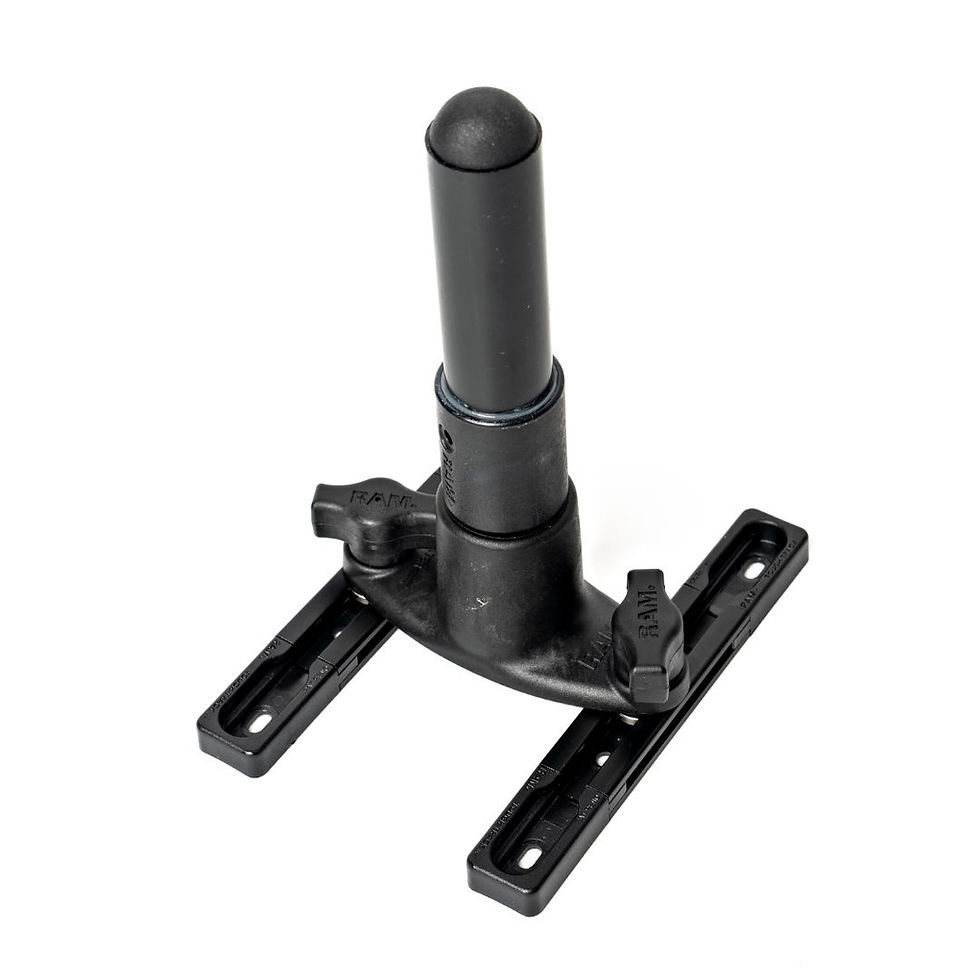
If you have a sit-on-top kayak with limited deck space, our Twin Track Mount may be an option.
This low-profile mount uses two parallel tracks installed on a mostly flat area directly in front of your seat. The base slides along the tracks to help adjust the paddle system's position.
What to measure
Mounting surface: A mostly flat deck area directly in front of the seat.
Track length: Room to install two tracks, each at least 3 inches long.
Track spacing: 3.5 inches apart, or 3.75 inches with the alternate base.
What else to look for
Allow room for the complete tracks and their attachment hardware. Confirm the required spacing with us before ordering or drilling.
Installation typically requires 3 to 4 drilled holes per track. If you cannot reach inside the kayak, an appropriate "blind" fastening method is needed, such as well-nuts, self-tapping screws or rivets.
The attachment method depends on your kayak and mounting location.
Which Kayak Paddle Mount Fits Other Kinds of Kayaks?
Foldable Kayaks
In some cases, the Apex Mount can work, depending on the internal structure and the presence of a mostly smooth, supportive floor area in front of the seat.

Sea or Touring Kayaks
The Apex Mount can work well with some sea kayaks, provided there is a mostly smooth floor area in front of the seat to support the mount.
Canoes
Canoes generally sit higher out of the water and are wider than typical kayaks. Because of this height and width, our systems are unlikely to work well in a canoe, though some customers have done it.
Inflatable Kayaks or Rafts
The Apex Mount may be an option for some inflatables, though secure attachment can be challenging and the flexible surface may cause it to rock or shift as you paddle. We recommend a rigid kayak for the best stability, but if the mount can be securely attached and you're comfortable with some side-to-side movement, this setup may still be worthwhile.
No Standard Mount fits? Custom Options Are Available

An unusual kayak layout does not necessarily rule out using an Angle Oar paddle system.
Custom mount options are available using parts from us, compatible third-party components, your own engineering ingenuity or a combination of all three.
We can help explore different bases, track lengths, support-post heights and attachment approaches. Some customers also design their own mounting solutions around their particular kayak, incorporating Angle Oar components into a custom-built support or removable base.
Each custom setup needs individual consideration. Send us photos and measurements so we can discuss what may be feasible.
Let Us Help You Check the Fit
You don't have to figure everything out from measurements alone.
Email us 2 to 4 photos showing:
Your cockpit or the area directly in front of your seat.
The same area from above and from the side.
Any molded features or obstructions that could affect placement.
Include your kayak's make, model and approximate year, if known, along with any measurements you have taken. Let us know whether you are considering the Versa Paddle System or the Gamut Paddle Holder System.
All our mounts work with both systems. We can help you narrow down the mounting options based on your kayak, seating position and paddling needs. Send photos to info@angleoar.com
For detailed measurements and installation videos, visit our Mount Specifications page.

