
Can Someone Who Has a Visual Impairment Kayak? Absolutely. Here's How.

Updated: Jul 4
"The biggest adaptation often isn't the equipment—it's the way we teach."
At this year's Veterans Administration Golden Age Games in Tampa, Florida, adaptive sports took center stage for hundreds of older veterans eager to stay active. Among the many competitive events was an entire division for veterans with visual impairments, highlighting just how many individuals are living active, fulfilling lives despite significant vision loss.

Kayaking wasn't part of the competition. Instead, it was offered as a demonstration event — an opportunity for veterans to experience paddle sports, some for the very first time.
Working alongside adaptive paddling instructors, physical and recreational therapists, plenty of volunteers and safety team, one observation quickly became clear: there is no single approach to teaching someone with a visual impairment to kayak. Some participants needed very little adaptation beyond clear communication. Others benefited from specialized teaching techniques or adaptive equipment during their first experience on the water.
The common denominator wasn't the kayak.
It was the instructor.
Why are so many veterans living with visual impairments?
Contrary to what many people assume, military service does not automatically result in a higher rate of blindness or low vision. However, veterans are more likely to experience vision-related challenges because of factors such as blast exposure, traumatic brain injury (TBI), penetrating eye injuries, diabetes and age-related eye disease. Even when eyesight itself remains intact, TBIs can affect visual processing, depth perception, eye movement or balance—creating challenges that aren't always obvious.
Organizations such as We Paddle and the Cal Poly Adapted Paddling Program have recognized these needs for years, offering specialized paddling clinics for veterans with visual impairments while emphasizing that each participant's abilities and goals are unique.
Visual impairment exists on a spectrum
The phrase visual impairment (VI) covers an incredibly wide range of vision.
Some paddlers may have only peripheral vision. Others may distinguish light from dark. Some have limited central vision, while others are completely blind.
That's why one of the first questions an adaptive instructor should ask isn't, "Can you see?"
It's:
"Tell me about your vision."
Understanding what someone can see is often far more useful than focusing on what they can't.
The surprising reality: many paddlers don't need adaptive equipment
Perhaps the biggest misconception about adaptive kayaking is that someone with a visual impairment automatically requires specialized gear.
Often, they don't.
Many experienced adaptive instructors begin with a completely standard kayak and paddle.
Instead of modifying the equipment, they modify the instruction.
Before ever launching, participants are encouraged to become familiar with the kayak by touch. They may trace the hull from bow to stern, locate the cockpit, identify foot braces, feel the paddle blades and learn where their hands belong on the shaft.
This tactile exploration creates a mental map long before the first paddle stroke. From there, instruction typically emphasizes communication more than mechanics.
Common strategies include:
allowing paddlers to explore the kayak and paddle with their hands
using consistent verbal prompts throughout the lesson
describing the environment before and during the trip
practicing paddle orientation on shore
using clock-face directions ("The dock is at your two o'clock.")
encouraging paddlers to listen for shoreline sounds, waves or nearby voices
introducing one skill at a time
providing frequent reassurance and feedback
Even something as simple as placing a small piece of textured tape on the paddle shaft or cockpit can help someone consistently locate hand position.
One adaptive paddler previously shared that tactile markers were the only modification he really wanted.
Everything else came through practice.
Teaching confidence before technique
The American Canoe Association recognizes that communication itself is an adaptive skill. In fact, the ACA offers specialized Advanced Communications Workshops that train instructors to successfully integrate paddlers with visual, hearing and speech impairments into paddle sports by adapting teaching methods—not simply equipment.
That philosophy aligns perfectly with what many adaptive instructors discover on the water.
A calm voice.
Clear instructions.
Predictable terminology.
Time to explore.
These often matter more than any adaptive device.
When adaptive equipment does make sense
Of course, there are situations where adaptive equipment can make learning easier.
Recently, Angle Oar clinical consultant Cathy Webster partnered with Green Mountain Adaptive Sports to work with a group of children between roughly 8 and 15 years old who had significant visual impairments and little or no kayaking experience.
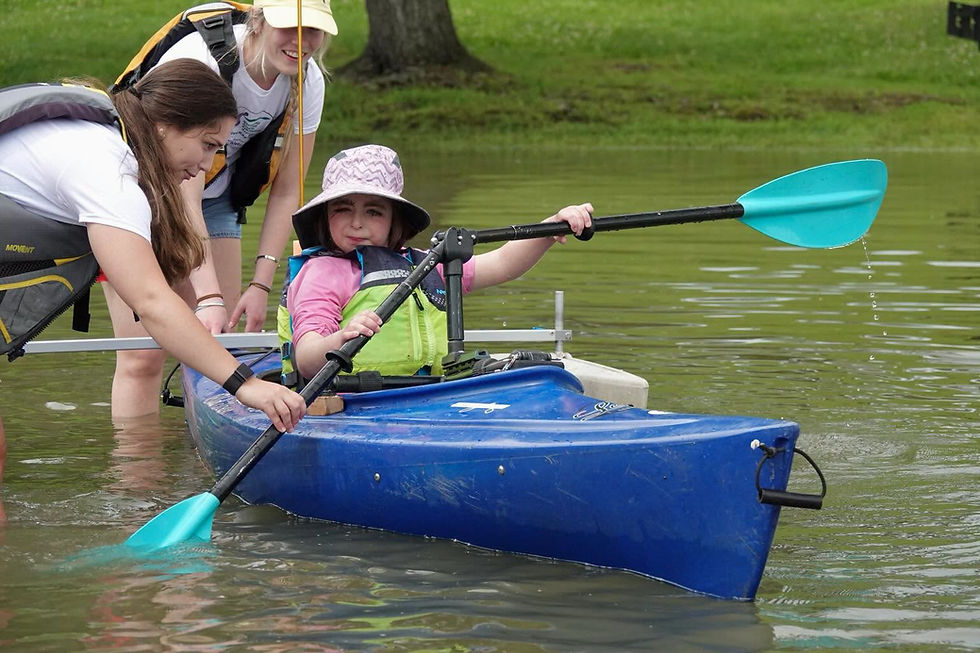
These weren't experienced paddlers adapting to vision loss.
They were learning kayaking from the very beginning.
Rather than asking them to master a traditional paddle immediately, Cathy introduced them to the Angle Oar's Versa Paddle.
Because the paddle remains supported and uses a simplified forearm-driven motion when set in the angled position, the children were able to focus first on understanding how the kayak moved through the water.
Another benefit surprised the instructors.

Since the paddle mount's center of gravity is in the center of the kayak, beginners tended to lean less from side to side than they often do with a traditional paddle. That allowed many of the students to concentrate on boat control and confidence before worrying about paddle mechanics.
Cathy's goal wasn't to replace the traditional kayak paddle.
It was to build a bridge toward it.
Once participants became comfortable moving the kayak and understanding basic strokes, they could gradually transition to a conventional paddle if that best suited their goals.
The same lesson played out at the Golden Age Games
That same flexibility was evident during the VA Golden Age Games.
Several veterans with significant visual impairments came to the adaptive kayaking demonstration.
No two experiences looked exactly alike.
Some participants, such as Bill, used a traditional paddle from the very beginning after receiving hands-on instruction and verbal coaching.
Others started with the Versa Paddle before progressing to a conventional paddle later in the session.
Watching those different approaches unfold reinforced an important principle: adaptive kayaking isn't about finding one perfect solution; it's about finding the right solution for each individual.
More than kayaking
Perhaps that's the greatest lesson adaptive paddling teaches all of us.
People with visual impairments don't necessarily need someone to do things for them. They need instructors willing to teach differently.
Organizations like Team River Runner have even demonstrated that veterans with blindness or low vision can progress well beyond introductory kayaking, participating in advanced paddling clinics and, in some cases, more challenging kayaking conditions.

The possibilities are often much greater than people imagine. With thoughtful instruction, good communication and a willingness to adapt the teaching—not just the equipment—kayaking becomes accessible to far more people than most of us ever realized.
Because in adaptive paddling, success isn't measured by how someone holds a paddle.
It's measured by the confidence they gain once they realize they can navigate the water on their own.
Angle Oar LLC's mission is getting people who didn’t think they had the strength or endurance to kayak out on the water and keeping experienced paddlers there longer! We provide adaptive paddles, outriggers and other equipment to people with shoulder problems, physical disabilities or limited upper body strength or mobility due to age, injury or ability.
